Roof Tiles’ Resistance to Frost
A question we are often asked concerns the frost resistance of our roof tiles. There is also a widespread misconception that links frost resistance with the water absorption of roof tiles.
Below we describe what actually applies – and why “Panagiotopoulos” roof tiles stand out.
European standard EN 1304
The specifications of ceramic (clay) roof tiles in the European Union are set by standard EN 1304:2005 “Clay roofing tiles and fittings – Product definitions and specifications”. It was approved by CEN (European Committee for Standardization) in March 2005 and published by ELOT in Greek in April 2005, replacing EN 1304:1998.
Under Joint Ministerial Decision 6690 (Government Gazette 1914/B/15.6.2012), compliance with this standard and CE marking of clay roof tiles are mandatory. It is therefore the standard that sets the requirements for clay roofing tiles and fittings for pitched roofs.
The following supplementary standards are specified as necessary for its application:
| EN 538 | Clay roofing tiles for discontinuous laying – Flexural strength test |
|---|---|
| EN 539-1 | Determination of physical characteristics – Part 1: Impermeability test |
| EN 539-2 | Determination of physical characteristics – Part 2: Test for frost resistance |
| EN 1024 | Clay roofing tiles for discontinuous laying – Determination of geometric characteristics |
| EN 13501-1 | Fire classification of construction products – Part 1: Reaction to fire tests |
| EN 13501-5 | Fire classification of construction products – Part 5: External fire exposure to roofs |
As regards frost resistance, EN 1304 refers to EN 539-2:
4.3 Frost resistance: Test specimens shall give satisfactory results after testing by the method or methods described in EN 539-2 that apply to the country in which the roofing tiles are used.EN 1304:2005, §4.3
Panagiotopoulos S.A. regularly carries out frost-resistance tests as part of its Factory Production Control system, using Method E of EN 539-2 – the commonly accepted method in all EU member states.
At this point, EN 1304:2005 also includes the following note:
NOTE 2 The various physical and mechanical characteristics referred to above are independent of one another. Thus a high measured water absorption in a roof tile does not necessarily mean that the tile has low frost resistance, and vice versa.EN 1304:2005, Note 2
Why it matters
The European standard itself refutes the view that a tile with high water absorption performs poorly in frost. The two properties are not directly related.
On the contrary, water absorption is a mark of quality in a ceramic tile: it makes the material breathable, allows the natural release of water vapour and the natural cooling of the roof.
Standard EN 539-2
The test methods for determining the frost resistance of roof tiles are set by European standard EN 539-2 “Clay roofing tiles for discontinuous laying – Determination of physical characteristics – Part 2: Test for frost resistance”.
The standard specifies five test methods (A, B, C, D, E). The first four are applied in certain countries, according to the table in EN 1304, while method E is applied by all CEN member states, with the requirement each one sets. This is the method our company applies.
The standard also defines terms for frost damage and for carrying out the tests. Tiles are tested in the condition in which they were sampled; if they were already installed on a building, the stresses they have suffered are taken into account when interpreting the results.
Method E in our laboratory
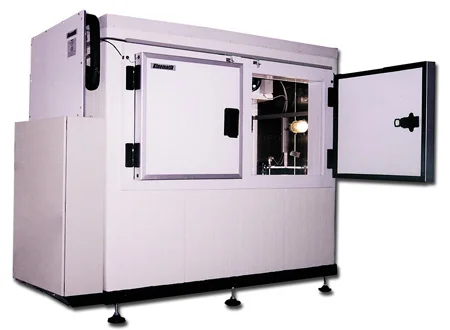
We will not analyse every method; we briefly describe method E, which we apply to test our production. Our laboratory has the equipment needed to carry it out as specified by the standard.
Principle of the method
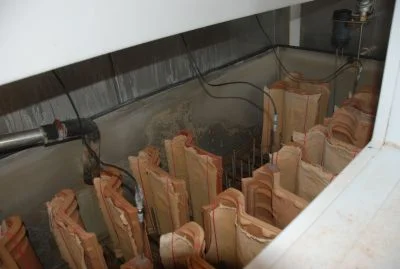
Specimens (tiles) are gradually immersed in water over seven days. Their back (underside) is then covered with a wet cloth and they are placed in a freezing chamber, where they undergo successive freeze–thaw cycles: frozen by a flow of cold air and thawed in water on all surfaces at the same time. During the test the specimens are visually inspected and any visible damage is recorded.
Apparatus
The freezing unit consists of the freezing chamber, a fan, a cooling system, a water-level regulator, a drain and a programming system. It is closed on all sides and has a frame to support the specimens. Inside there are calibrated temperature sensors with an error not exceeding ±0.5 K (0.5 °C).
The procedure step by step
- Drying and weighingThe specimens are dried for 24 hours at 110 ± 5 °C, cooled to room temperature and weighed one by one to the nearest gram (dry mass).
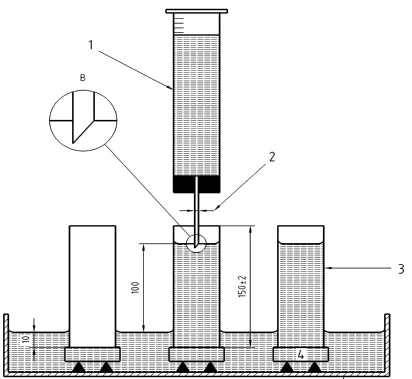
- Gradual immersionThey are placed in an open container of water immersed to 1/5 of their height. Every 24 hours water is added (2/5, 3/5…) until they are fully covered.
- SaturationOn the fifth day, with the specimens fully covered, an extra 50 mm of water is added and they are left to soak for 72 hours.
- Water absorptionThe fully saturated specimens are wiped with a damp sponge and weighed (wet mass). Water absorption Wu is calculated as a percentage of the dry mass.
- Wet clothThe back of each specimen is covered with wet linen cloth, cut to its shape and held with copper wire or rubber bands. It simulates the most adverse frost conditions, with permanent moisture.
- Freeze–thaw cyclesThe specimens are placed on the unit’s frame, set according to their type, and the cycles are carried out without interruption.
Evaluation
The specimens are examined on all sides with the naked eye from 30–40 cm under normal lighting. The type, extent and position of any damage are recorded. After each intermediate examination the cloth is replaced and the next cycle starts with a thawing phase (in the presence of water), so the specimens do not dry out.
The sample is classified at a level if, after the corresponding number of cycles, it shows none of the unacceptable damage listed in Table 3 of the standard:
After 150 cycles the highest level has been reached; the test continues only to find out in which cycle any unacceptable damage would appear.
Quality through procedures
The procedure is described in Work Instruction 051 “Operation & Calibration of the Roof Tile Frost Resistance Freezing Chamber” of the company’s Quality and Environmental Management System (ISO 9001 & ISO 14001). The apparatus is computer-controlled with a visual display system (SCADA), and its temperature sensors are calibrated every year by an external accredited body.
Conclusion
“Panagiotopoulos” roof tiles are of excellent quality, and the company takes every necessary measure to ensure their compliance with the European Standards.
EN 1304:2005 clearly states that the different properties of roof tiles are not necessarily linked (Note 2) – so water absorption does not determine frost resistance. Moreover, method E is carried out in full saturation: the samples are kept in water gradually for 4 days and fully for another 4, have a wet cloth throughout the test and are covered with water again at every thaw.
Under these adverse conditions our roof tiles perform excellently – which is what allows us to cover them with a written warranty of unlimited duration.
Our testing laboratory is at the disposal of our customers and building professionals for any test. Contact us →
- EN 1304:2005, Hellenic Organization for Standardization (ELOT), Athens, April 2005
- EN 539-1:2005, Hellenic Organization for Standardization, Athens, September 2005
- EN 539-2:2006, Hellenic Organization for Standardization, Athens, September 2005