

Energy Ceramic
Bricks
Energy Ceramic
Bioclimatic building with the “Energy Ceramic” thermal insulating brick system.
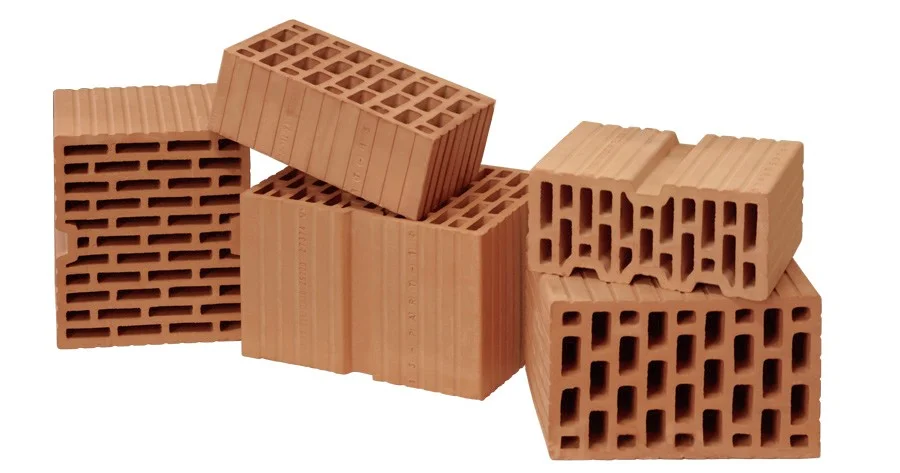
With single-leaf masonry made of “Energy Ceramic” thermal insulating bricks, you bring the principles of bioclimatic design into your new home: lower heating, cooling and lighting needs, a better microclimate, smooth integration of the building into its surroundings and maximum quality of life.
A complete range of thermal insulating bricks is available, in sizes that cover every single-leaf masonry application.
⬇ Download the circular (PDF in Greek, 584 KB)
Less energy
Lower heating, cooling and lighting needs, with thermal inertia that stores heat.
+10% building area
Insulating units with λ’ ≤ 0.30 W/mK, not counted in the building coefficient.
Natural material
Clay, water and fire: recyclable, long life cycle, healthy indoor climate.
Products & thermal properties
| Product | 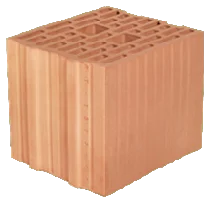 Energy Ceramic 20 cm | 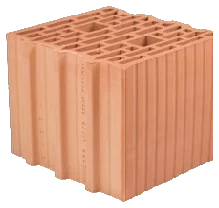 Energy Ceramic 25 cm | 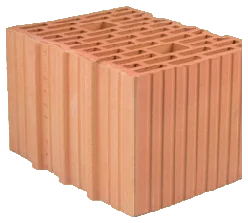 Energy Ceramic 30 cm | 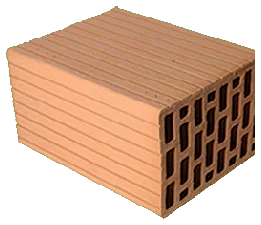 Energy Ceramic 25 cm horizontal |
|---|---|---|---|---|
| General characteristics | ||||
| Dimensions (cm) | 22 × 20 × 19 | 22 × 25 × 19 | 22 × 30 × 19 | 30 × 25 × 17 |
| Pieces / m² | 21 mortar 8 mm 22 adhesive 3 mm | 21 mortar 8 mm 22 adhesive 3 mm | 21 mortar 8 mm 22 adhesive 3 mm | 18 mortar 8 mm 19 adhesive 3 mm |
| Weight / piece | 7.1 kg | 9.1 kg | 10.3 kg | 10.7 kg |
| Compressive strength | 10 N/mm² bearing face 22 × 20 | 10 N/mm² bearing face 22 × 25 | 10 N/mm² bearing face 22 × 30 | 5 N/mm² bearing face 25 × 30 |
| Thermal properties (W/mK) | ||||
| Thermal conductivity of unitλ10,dry,unit (P4) | 0.197 | 0.206 | 0.197 | 0.226 |
| Thermal conductivity of masonryλ10,dry,masonry – adhesive 3 mm | 0.198 | 0.207 | 0.211 | 0.237 |
| Thermal conductivity of masonryλ10,dry,masonry – mortar 8 mm | 0.214 | 0.223 | 0.233 | 0.252 |
| Design thermal conductivityλ10,design,masonry – adhesive 3 mm 4% moisture by volume, per KENAK | 0.246 | 0.257 | 0.262 | 0.294 |
| Design thermal conductivityλ10,design,masonry – mortar 8 mm 4% moisture by volume, per KENAK | 0.265 | 0.277 | 0.289 | 0.312 |
Thermal conductivity values in W/mK. Highlighted: design values per KENAK. λ’ ≤ 0.30 W/mK: the bricks are not counted in the building coefficient.
The thermal properties of our products comply with ELOT EN 1745:2012 and ELOT EN 6946:2009, while the calculation method has been validated according to ELOT EN ISO 10211:2009.
The advantages of single-leaf masonry
Thermal inertia – heat capacity
The special hole pattern, combined with high heat capacity, reduces heat losses and increases thermal inertia: the wall becomes an energy “store”. In winter, solar gains are used for many hours; in summer, the coolness of night ventilation is retained.
Thermal insulation
The increased insulating capacity reduces the need for additional insulation, meeting KENAK requirements in the best and most economical way. Thermal properties have been calculated and optimised with modern simulation methods.
Ideal microclimate
Thanks to the porosity of their mass, bricks act as humidity regulators: they release moisture when the air is dry and absorb it when it is humid.
Combined benefits
Better indoor climate, heat storage and thermal insulation, earthquake resistance and increased fire resistance – essential qualities for bioclimatic buildings and total-quality constructions.
Single-leaf masonry, i.e. masonry made of thick bricks with high thermal resistance, has significant advantages over any other form of construction: excellent earthquake and fire resistance, significant sound insulation and remarkable thermal insulation, which, combined with high heat capacity and relatively low cost, make it a unique building element for low-energy buildings. During an earthquake it performs much better than double masonry with a cavity.
Elizabeth Vintzileou, Professor, National Technical University of Athens
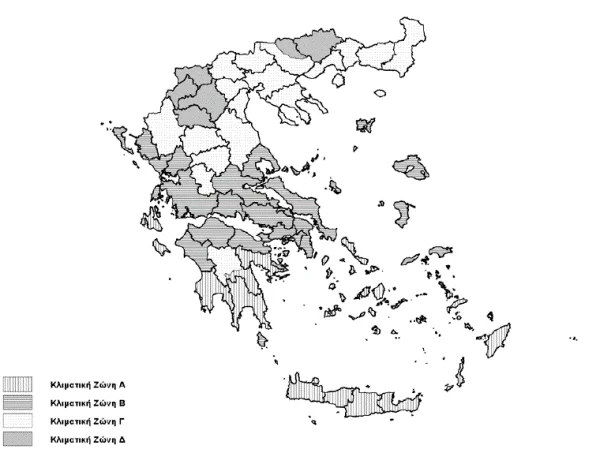
KENAK climate zones
Heraklion, Chania, Rethymno, Lasithi, Cyclades, Dodecanese, Samos, Messinia, Laconia, Argolida, Zakynthos, Kefalonia & Ithaca, Kythira & Saronic islands, Arcadia (lowlands)
Attica (except Kythira & Saronic islands), Corinthia, Ilia, Achaia, Aetolia-Acarnania, Fthiotida, Fokida, Boeotia, Evia, Magnesia, Lesvos, Chios, Corfu, Lefkada, Thesprotia, Preveza, Arta
Arcadia (mountainous), Evrytania, Ioannina, Larissa, Karditsa, Trikala, Pieria, Imathia, Pella, Thessaloniki, Kilkis, Chalkidiki, Serres (except NE part), Kavala, Xanthi, Rhodope, Evros
Grevena, Kozani, Kastoria, Florina, Serres (NE part), Drama
In each prefecture, areas above 500 m altitude belong to the next colder zone. Zone D includes all areas regardless of altitude.
Build with Panagiotopoulos bricks
Available at building materials stores. For technical information and help choosing the right masonry, our team is at your disposal.
Are you a building materials dealer or a construction company? Contact us about working together.